- Article

- Global Investment Research
- Demographics
- Future consumer
The next generation of spenders
The coming upper-income boom.
Over the next 25 years, the global economy is set to have 1.2 billion more middle- and upper-income consumers. We expect the upper-income group to make the greatest contribution to consumer spending growth, particularly in Asia – with recreation spending the key beneficiary.
This has been a decade with (so far) a global pandemic, followed by a big surge in inflation, supply chain disruptions, and geopolitical volatility. Yet, throughout all of these adverse shocks, consumer spending has remained impressively resilient.
The resilience hasn’t been evenly spread. Particularly in the last couple of years, it’s the highest income, wealthiest consumers who have been really driving consumer spending growth – both in the US and globally.
But who will drive the consumer spending of the future? In our new report, we zoom out over a long time horizon and examine the structural trends – demographics, and consumer spending behaviour – that could reshape the balance of the global consumer over the next few decades.
We have generated estimates across more than 140 economies, representing more than 95% of the world population, about: the number of new consumers we will see in different income brackets in the coming years and decades; where these consumers will live, and where the biggest areas of consumer spending growth will be.
Our income brackets cover lower-income (less than USD20 per person, per day), emerging (USD20-50pppd), aspirational (USD50-110pppd), established (USD110-200pppd), and higher (more than USD200pppd) categories. These are based on purchasing power parity exchange rates, which also account for the differing costs of living across economies.
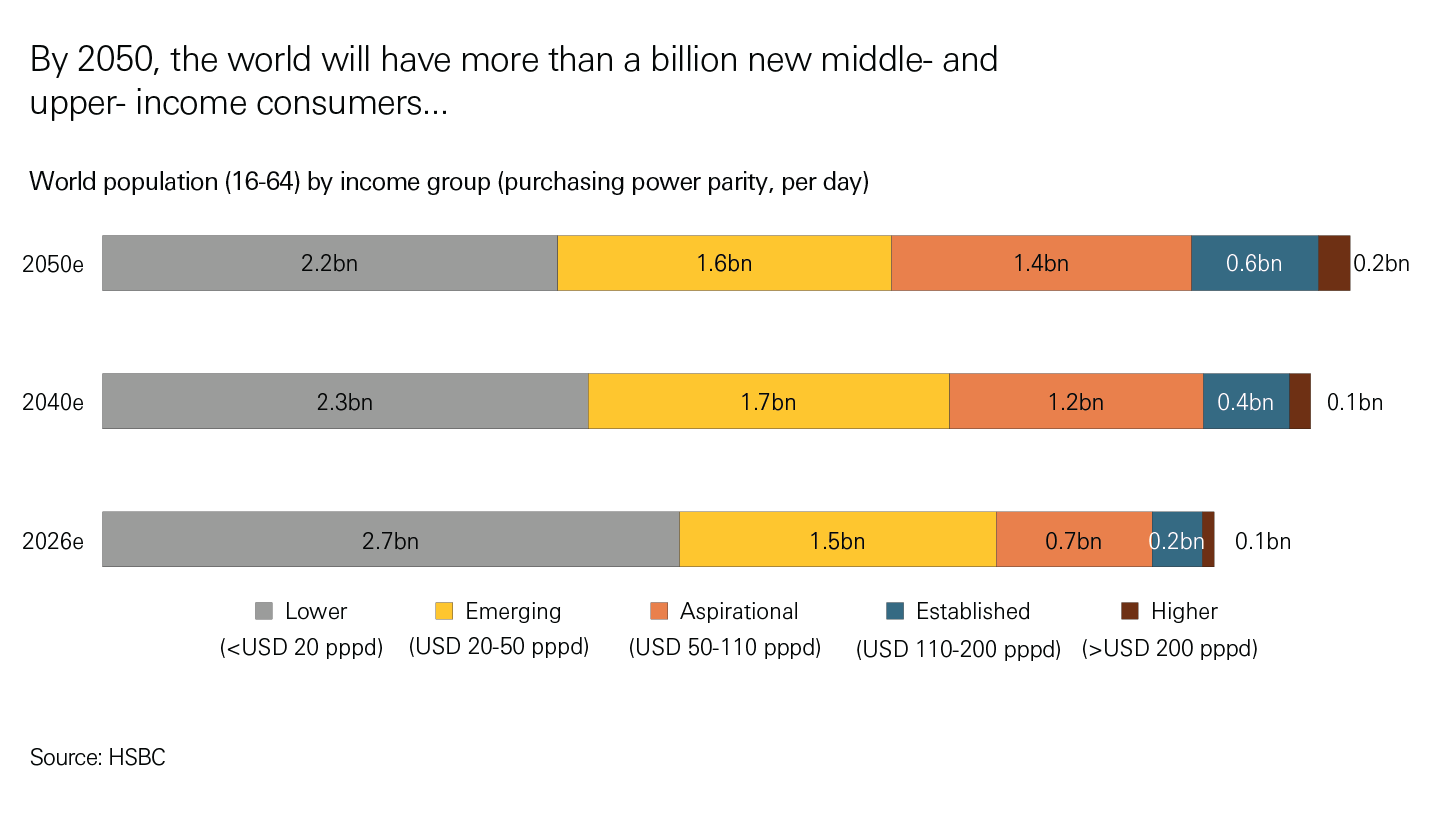
The key takeaways? We expect the total middle- and upper-income population to grow by 1.2 billion between now and 2050.
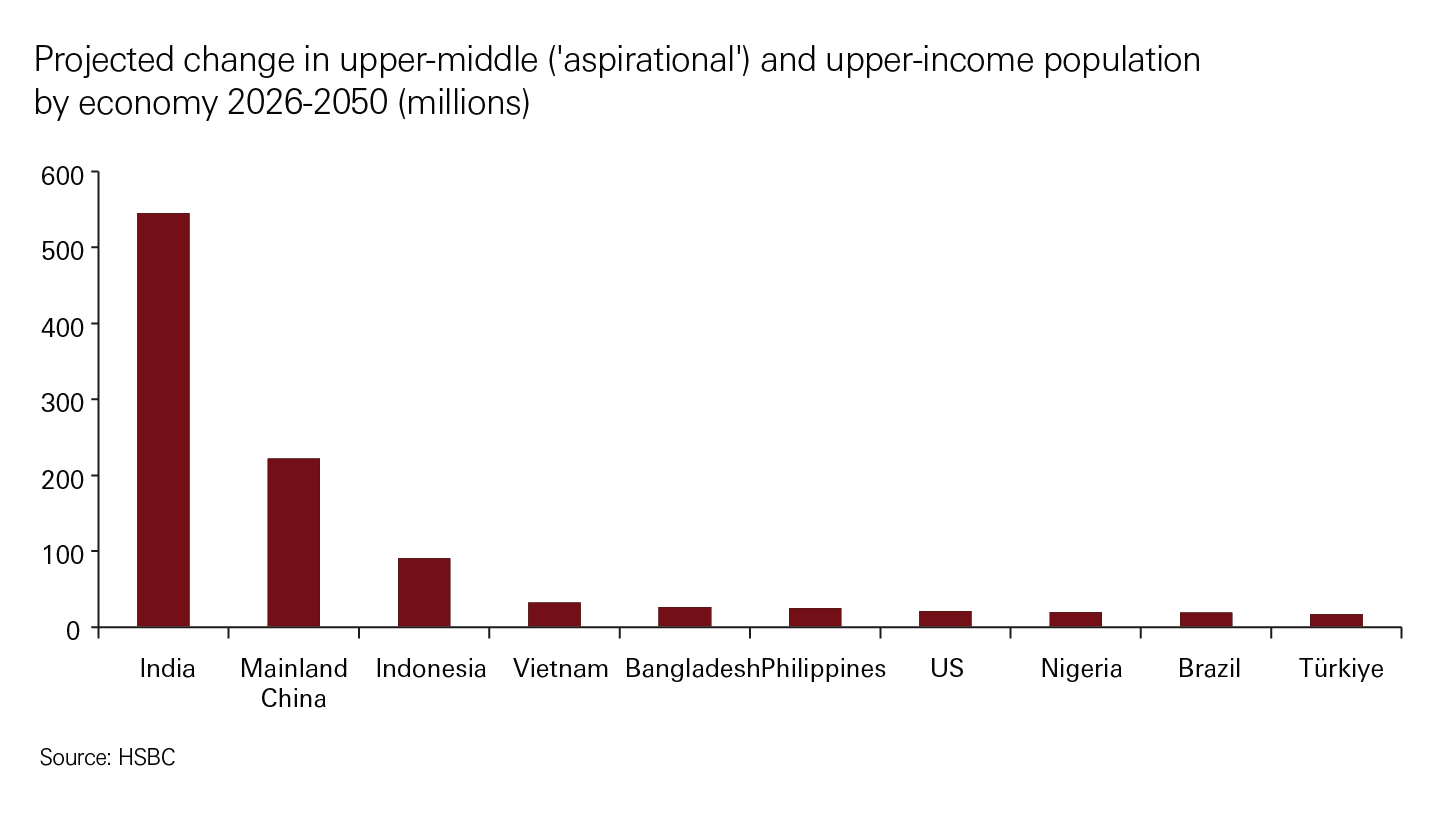
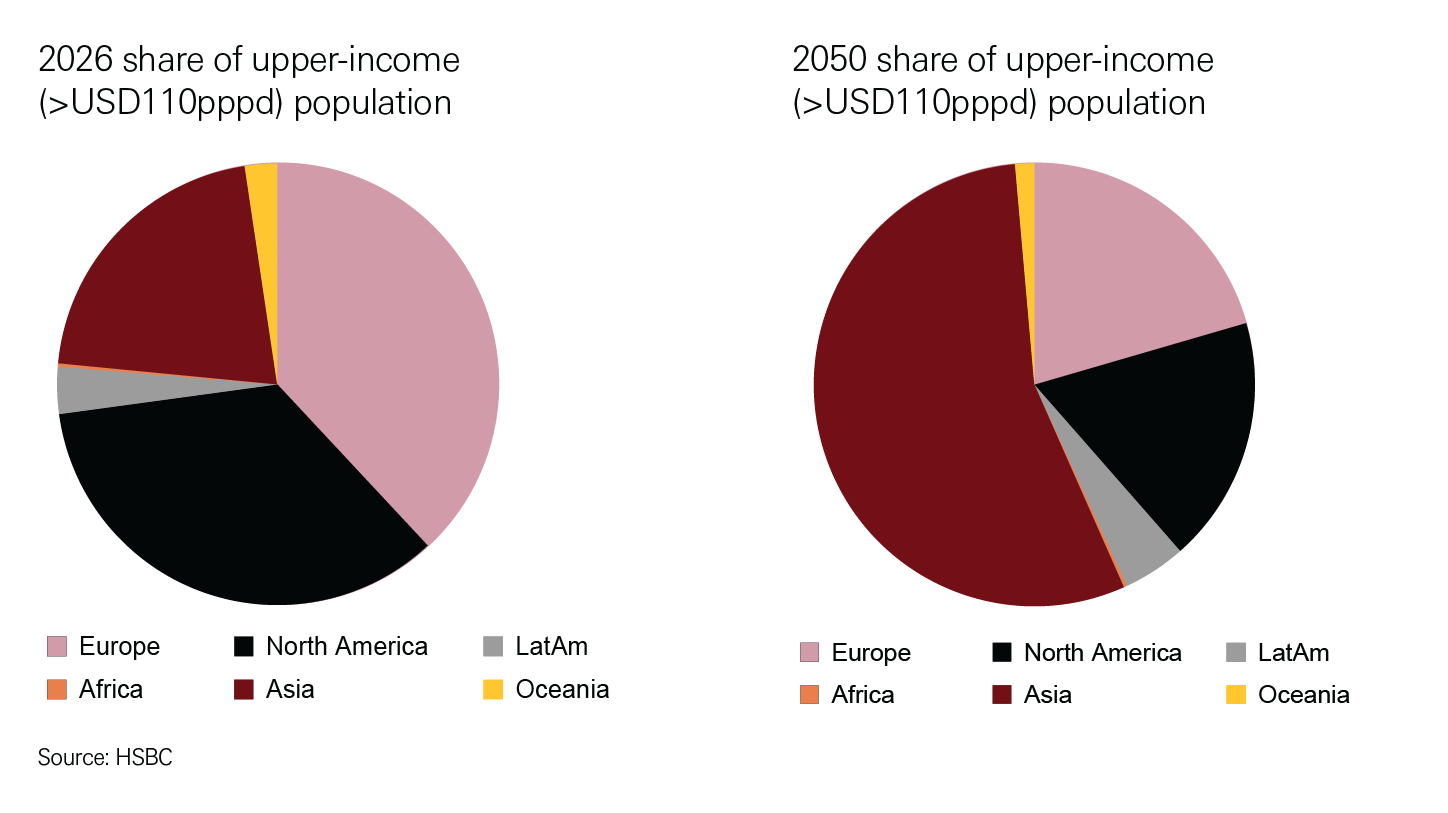
Economies we currently call emerging markets play a pivotal role. Asia is set to account for more than three-quarters of this growth, with India alone accounting for close to 50%. Africa, meanwhile, should account for 23% of the growth in middle-income consumers (though skewed to the lower-middle end).
Ageing demographics mean Europe, North America and Oceania are projected to see a fall in their overall working-age populations – but the movement of consumers up the income distribution means their upper-income population is nonetheless set to rise 75%.
Across the world, our modelling points to global real consumer spending growing by roughly 2.4% per year out to 2050. Asia is set to be the greatest regional contributor to the global figure, with annual consumer spending growth of 3.4%.
In terms of sectors, we expect recreation to be the greatest beneficiary, with spending rising by 3.0% a year (4.0% within upper-income consumers). As an economy becomes richer, the share of income spent by consumers on basic subsistence goods like food falls, while the share spent on discretionary spending categories rises – including “fun” purchases, from travel to live sports and music, cinema, and dining out.
In sum, then, the coming decades suggest a shift not only in the geographic distribution of consumer spending, but also in the sectors that stand to leverage this growth. Understanding these trends could be key to spotting long-term opportunities in the years ahead.
Would you like to find out more? Subscribers to HSBC Global Investment Research can 'click here*' to read the full report.
To learn more about HSBC Global Investment Research, including how to subscribe, please email us at AskResearch@HSBC.com
*Please note that by clicking on this link you are leaving the HSBC Corporate & Institutional Banking website, therefore please be aware that the external site policies will differ from our website terms and conditions and privacy policy. The next site will open in a new browser window or tab.
The following analyst(s), who is(are) primarily responsible for this document, certifies(y) that the opinion(s), views or forecasts expressed herein accurately reflect their personal view(s) and that no part of their compensation was, is or will be directly or indirectly related to the specific recommendation(s) or views contained in this research report: Bethan Ellis and James Pomeroy
This document has been issued by the Research Department of HSBC.
HSBC and its affiliates will from time to time sell to and buy from customers the securities/instruments, both equity and debt (including derivatives) of companies covered in HSBC Research on a principal or agency basis or act as a market maker or liquidity provider in the securities/instruments mentioned in this report.
Analysts, economists, and strategists are paid in part by reference to the profitability of HSBC which includes investment banking, sales & trading, and principal trading revenues.
Whether, or in what time frame, an update of this analysis will be published is not determined in advance.
For disclosures in respect of any company mentioned in this report, please see the most recently published report on that company available at www.hsbcnet.com/research.
HSBC may use Artificial Intelligence (AI) tools approved for adoption within HSBC in the development of its research reports, utilizing these technologies to analyse large volumes of data, enhance efficiency and improve the overall user experience. This includes but is not limited to paraphrasing, developing suitable captions and supporting data visualisation. It is important to note that while AI tools assist in various aspects of report creation, all investment recommendations and opinions presented herein are formulated and approved exclusively by our research analysts. The final content of the report reflects the professional judgement and expertise of our research analysts, ensuring compliance with regulatory standards and maintaining the integrity of our research process.
Additional disclosures
- This report is dated as at 07 September 2026.
- All market data included in this report are dated as at close 04 September 2026, unless a different date and/or a specific time of day is indicated in the report.
- HSBC has procedures in place to identify and manage any potential conflicts of interest that arise in connection with its Research business. HSBC's analysts and its other staff who are involved in the preparation and dissemination of Research operate and have a management reporting line independent of HSBC's Investment Banking business. Information Barrier procedures are in place between the Investment Banking, Principal Trading, and Research businesses to ensure that any confidential and/or price sensitive information is handled in an appropriate manner.
- You are not permitted to use, for reference, any data in this document for the purpose of (i) determining the interest payable, or other sums due, under loan agreements or under other financial contracts or instruments, (ii) determining the price at which a financial instrument may be bought or sold or traded or redeemed, or the value of a financial instrument, and/or (iii) measuring the performance of a financial instrument or of an investment fund.
This document has been issued by HSBC Bank plc, which has based this document on information obtained from sources it believes to be reliable but which it has not independently verified. Neither HSBC Bank plc nor any member of its group companies (“HSBC”) make any guarantee, representation or warranty nor accept any responsibility or liability as to the accuracy or completeness of this document and is not responsible for errors of transmission of factual or analytical data, nor is HSBC liable for damages arising out of any person’s reliance on this information. The information and opinions contained within the report are based upon publicly available information at the time of publication, represent the present judgment of HSBC and are subject to change without notice.
This document is not and should not be construed as an offer to sell or solicitation of an offer to purchase or subscribe for any investment or other investment products mentioned in it and/or to participate in any trading strategy. It does not constitute a prospectus or other offering document. Information in this document is general and should not be construed as personal advice, given it has been prepared without taking account of the objectives, financial situation or needs of any particular investor. Accordingly, investors should, before acting on it, consider the appropriateness of the information, having regard to their objectives, financial situation and needs. If necessary, seek professional investment and tax advice.
The decision and responsibility on whether or not to purchase, subscribe or sell (as applicable) must be taken by the investor. In no event will any member of the HSBC group be liable to the recipient for any direct or indirect or any other damages of any kind arising from or in connection with reliance on any information and materials herein.
Past performance is not necessarily a guide to future performance. The value of any investment or income may go down as well as up and you may not get back the full amount invested. Where an investment is denominated in a currency other than the local currency of the recipient of the research report, changes in the exchange rates may have an adverse effect on the value, price or income of that investment. In case of investments for which there is no recognised market it may be difficult for investors to sell their investments or to obtain reliable information about its value or the extent of the risk to which it is exposed. Some of the statements contained in this document may be considered forward looking statements which provide current expectations or forecasts of future events. Such forward looking statements are not guarantees of future performance or events and involve risks and uncertainties. Actual results may differ materially from those described in such forward-looking statements as a result of various factors.
This document is for information purposes only and may not be redistributed or passed on, directly or indirectly, to any other person, in whole or in part, for any purpose. The distribution of this document in other jurisdictions may be restricted by law, and persons into whose possession this document comes should inform themselves about, and observe, any such restrictions. By accepting this report, you agree to be bound by the foregoing instructions. If this report is received by a customer of an affiliate of HSBC, its provision to the recipient is subject to the terms of business in place between the recipient and such affiliate. The document is intended to be distributed in its entirety. Unless governing law permits otherwise, you must contact a HSBC Group member in your home jurisdiction if you wish to use HSBC Group services in effecting a transaction in any investment mentioned in this document.
Certain investment products mentioned in this document may not be eligible for sale in some states or countries, and they may not be suitable for all types of investors. Investors should consult with their HSBC representative regarding the suitability of the investment products mentioned in this document.
HSBC and/or its officers, directors and employees may have positions in any securities in companies mentioned in this document. HSBC may act as market maker or may have assumed an underwriting commitment in the securities of companies discussed in this document (or in related investments), may sell or buy securities and may also perform or seek to perform investment banking or underwriting services for or relating to those companies and may also be represented on the supervisory board or any other committee of those companies.
From time to time research analysts conduct site visits of covered issuers. HSBC policies prohibit research analysts from accepting payment or reimbursement for travel expenses from the issuer for such visits.
HSBC Bank plc is registered in England No 14259, is authorised by the Prudential Regulation Authority and regulated by the Financial Conduct Authority and the Prudential Regulation Authority and is a member of the London Stock Exchange.
Should you wish to use AI technology (computational, statistical, machine-learning or other artificial intelligence techniques to infer or learn from data to find patterns, take actions, make decisions, or generate output) to help you analyse, summarise or evaluate this publication and/or any other research materials provided to you by HSBC, you shall seek HSBC consent in advance of any such use and not upload this publication and/or any other research materials produced by HSBC to an AI system or otherwise use AI technology in connection with the research services HSBC provides to you without our consent.
© Copyright 2026, HSBC Bank plc, ALL RIGHTS RESERVED. No part of this publication may be reproduced, stored in a retrieval system, or transmitted, on any form or by any means, electronic, mechanical, photocopying, recording, or otherwise, without the prior written permission of the issuer of the report.
Issuer of report
HSBC Bank plc.

The billions of AI consumer surplus
While much of focus on AI’s impact on the economy has been on corporate usage, the labour market and corporate profits, including our own work, there is an additional angle which could have profound implications. Simply, the free nature of many personal-use AI tools is generating an enormous consumer surplus, as many household purchases are avoided or time is saved.