- Article

- Global Investment Research
- Emerging markets
HSBC Emerging Markets Sentiment Survey – No country for bears
The last couple of months have been a proper resilience test for emerging markets (EM). The Middle East conflict and the associated surge in commodity prices – oil and gas in particular – added a fresh layer of uncertainty.
HSBC EM Sentiment Survey: ‘Cautious, not bearish’
Rising inflation risks, a sharp hawkish repricing of monetary policy, a broadly stronger US dollar and greater uncertainty around activity meant it was hardly business as usual. And yet, EM appears to have passed the test, based on the results of HSBC’s 24th EM Sentiment Survey, conducted by Survation between 5 May and 17 June (covering 101 investors from 101 institutions, and representing USD432bn of EM assets under management).
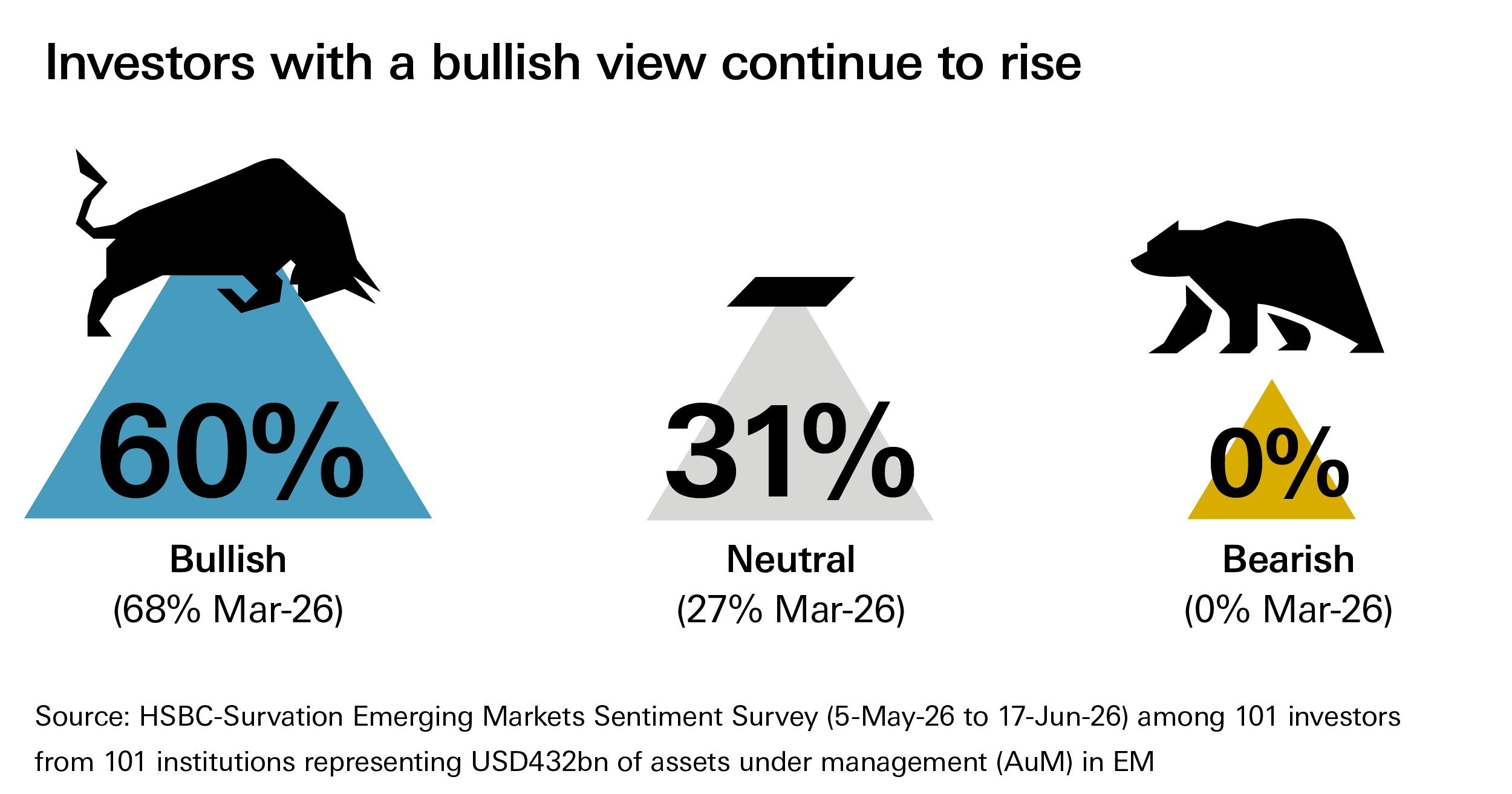
Bullish sentiment moderated to 60% from 68% in March, but, for a third consecutive survey, no respondent was bearish, leaving net sentiment at a still-elevated 60%. The details, however, are more cautious. Investors de-risked across all major EM asset classes.
Equities remain the largest net overweight, but net positioning fell to 35% from 57%. Net positioning in EM FX more than halved to 24% from 63%, while external debt (EXD) dropped to 22% from 48%. Local currency debt (LCD) remained the weakest asset class, with net positioning deteriorating further to -32% from -21%.
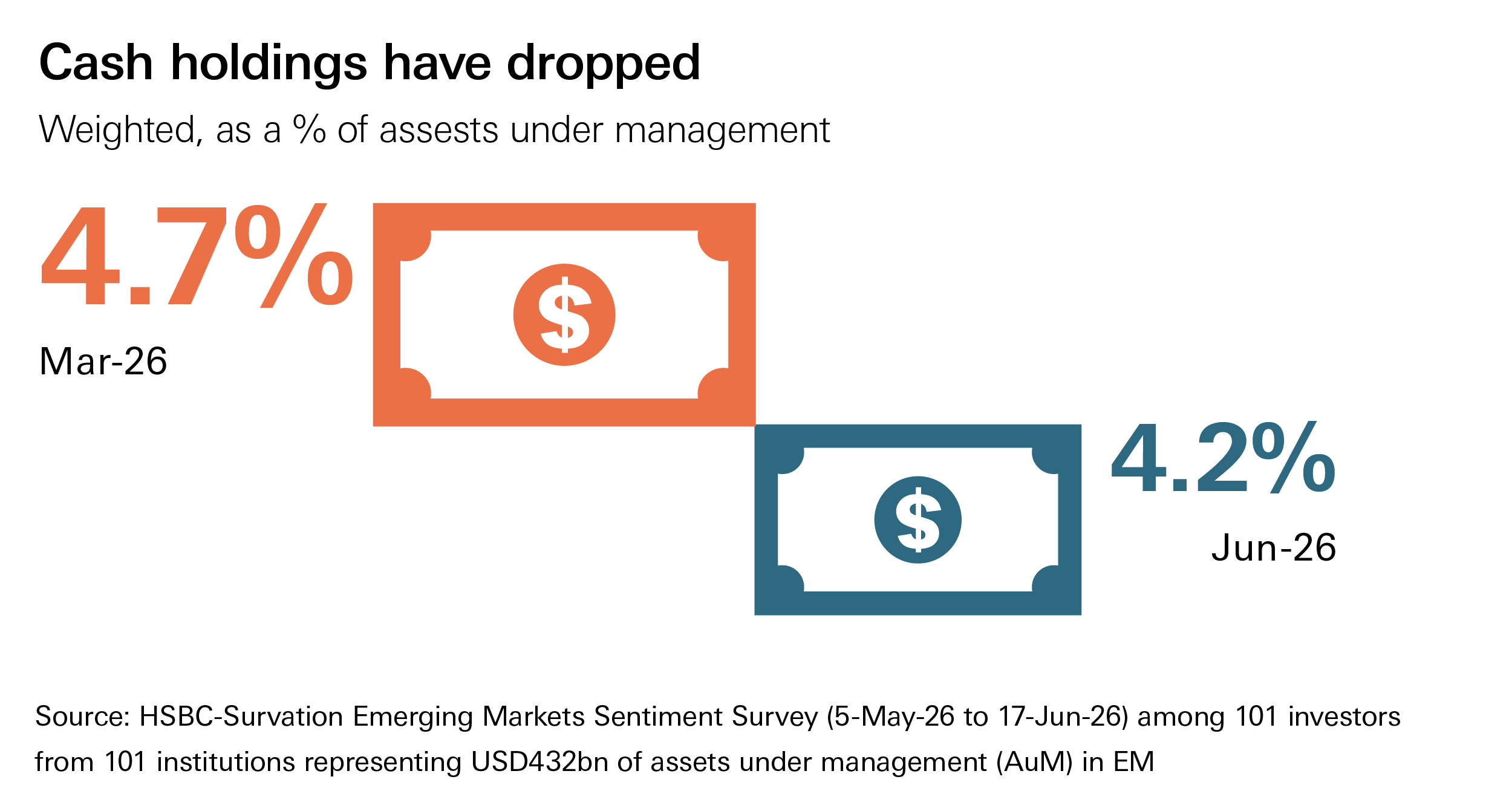
Despite lighter positioning, investors did not build additional dry powder. Weighted average cash holdings edged down to 4.2% of assets under management from 4.7%, while the share of investors holding more than 10% in cash fell to zero from 15%. Looking ahead, however, intentions have turned more defensive as 37% plan to increase cash holdings, while only 18% expect to reduce them.
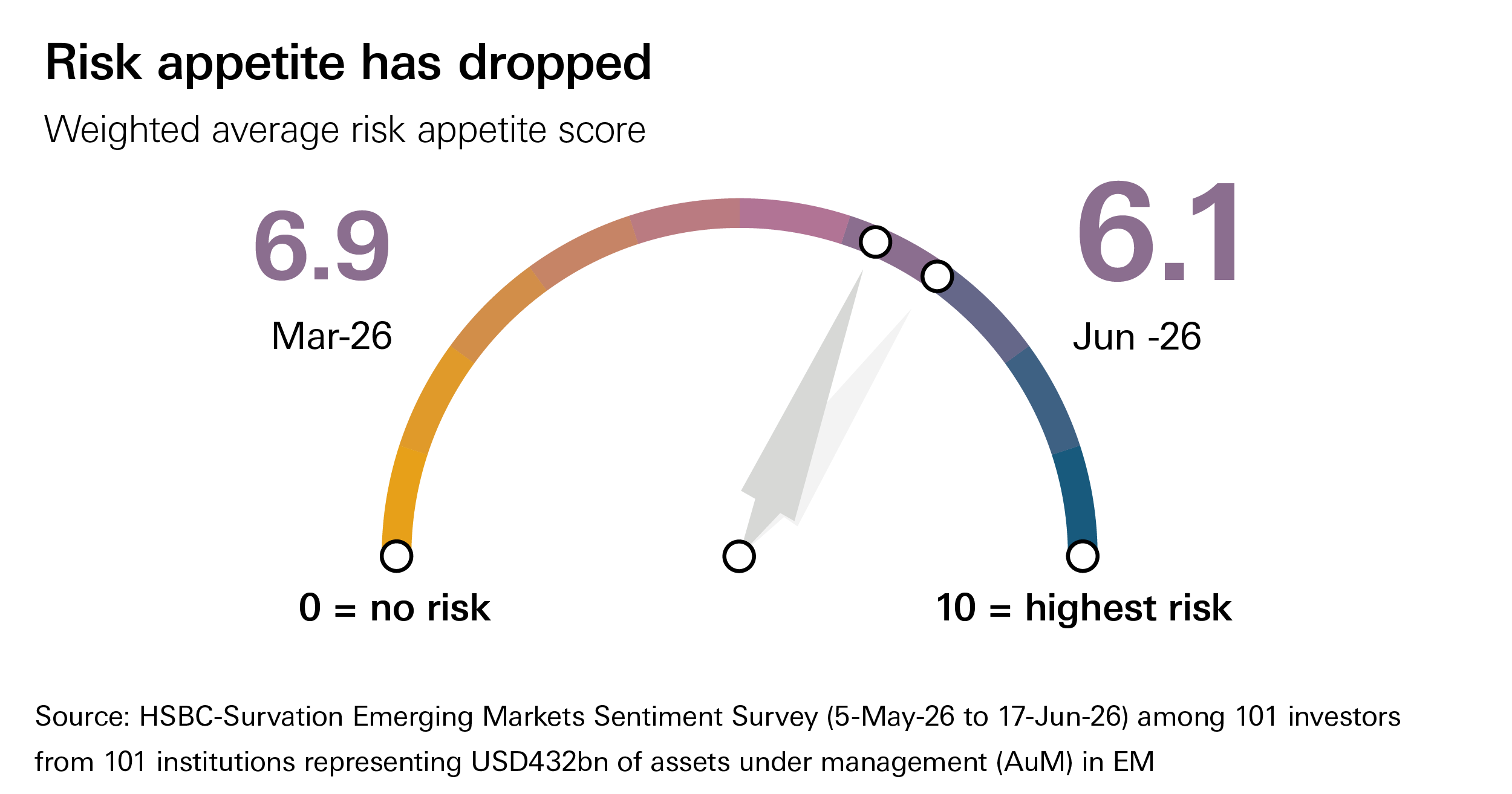
In line with higher intention to hold cash, risk appetite also deteriorated sharply, with the weighted average score falling to 6.1 from 6.9. The main macro shift was a marked worsening in inflation expectations and a hawkish repricing of rates. More than 80% of respondents now expect inflation to be higher both in EM and DM over the next 12 months, while expectations for both policy rates have shifted decisively higher. No respondent expects rate cuts. In EM, 56% expect policy rates to rise over the next three months, reinforcing the view that there is very limited room for near-term easing.
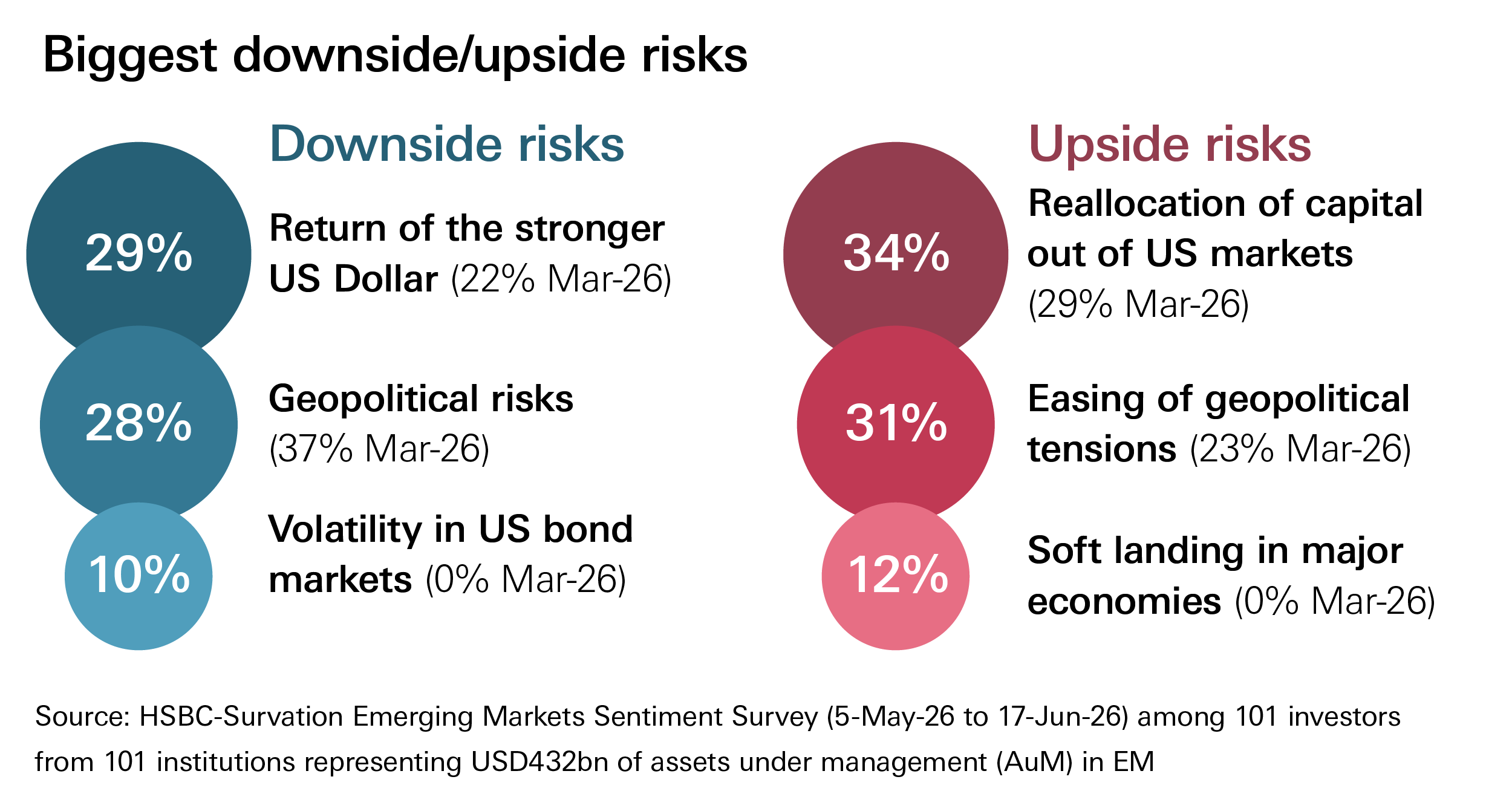
A stronger US dollar is now seen as the main downside risk to EM, cited by 29% of respondents, followed by geopolitics at 28%. On the upside, investors are increasingly focused on a narrower set of catalysts. Reallocation of capital out of the US remains the leading potential support, cited by 34%, followed by an easing of geopolitical tensions at 31%.
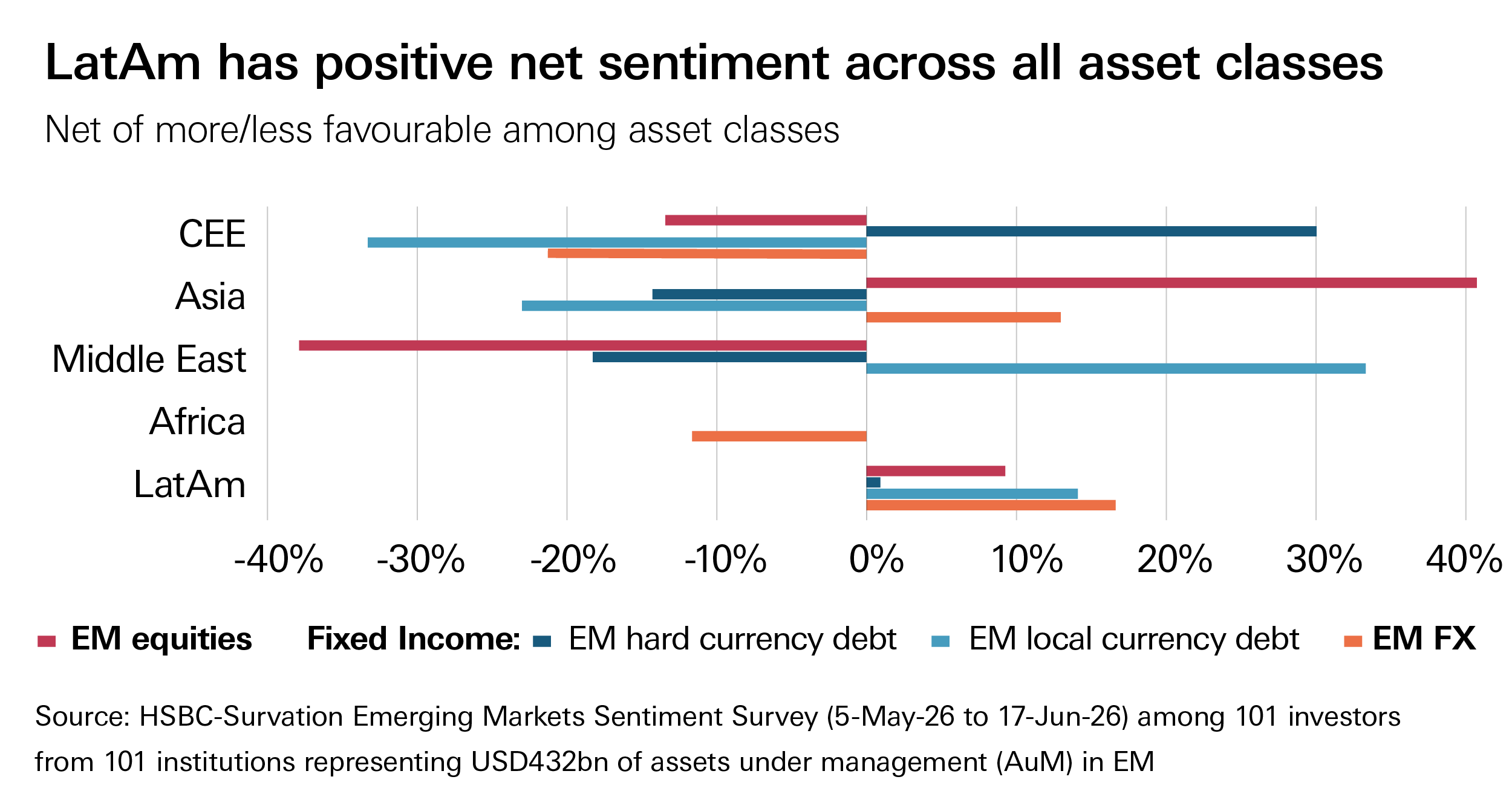
Regional preferences have also rotated. LatAm remains the only region with positive net sentiment across all asset classes. Asia is still the clear favourite for equities, while in fixed income, preferences are split: the Middle East leads for LCD, while Central and Eastern Europe stands out for EXD.
Investors remain constructive on EM equities, with 67% expecting further gains. Confidence in relative performance has weakened, however: 52% now expect EM equities to outperform DM, down from 78%, while 27% anticipate underperformance. EM FX sentiment also softened sharply, with net appreciation expectations falling to 9% from 42%. Within fixed income, preferences have flipped decisively towards hard currency debt.
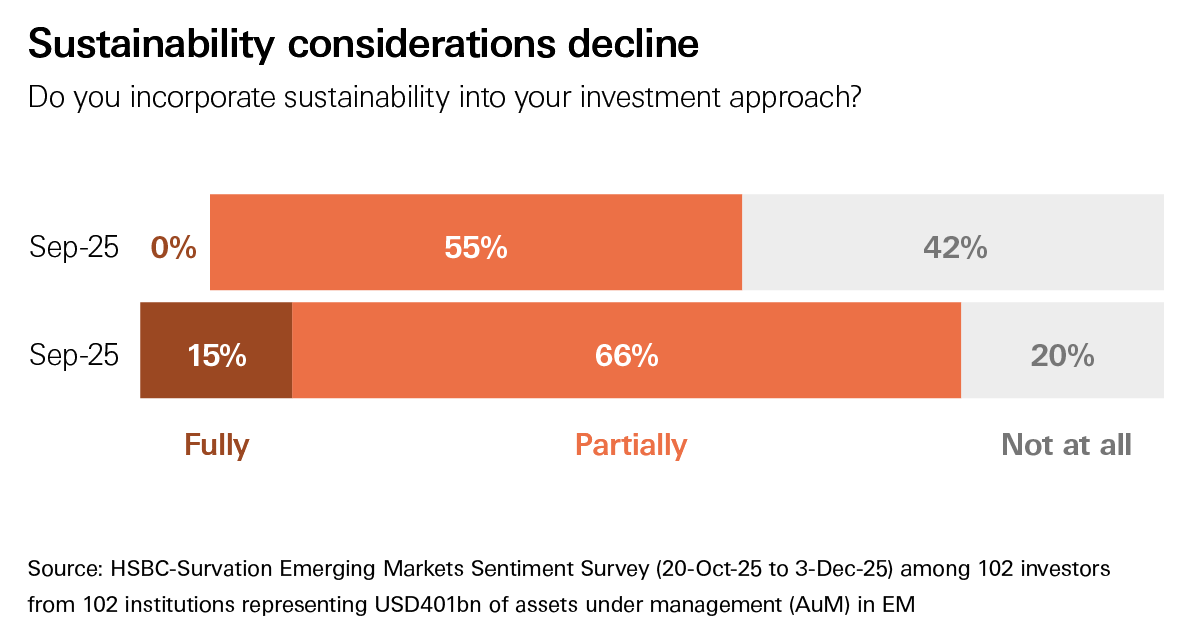
On sustainability, integration into investment decision-making continues to increase. However, investors still identify insufficient funding and a lack of clear planning as the main obstacles to achieving net zero.
Would you like to find out more? Subscribers to HSBC Global Investment Research can click here to read the full report*.
To learn more about HSBC Global Investment Research, including how to subscribe, please email us at AskResearch@HSBC.com
*Please note that by clicking on this link you are leaving the HSBC Corporate & Institutional Banking website, therefore please be aware that the external site policies will differ from our website terms and conditions and privacy policy. The next site will open in a new browser window or tab
Analyst Certification
The following analyst(s), economist(s), or strategist(s) who is(are) primarily responsible for this report, including any analyst(s) whose name(s) appear(s) as author of an individual section or sections of the report and any analyst(s) named as the covering analyst(s) of a subsidiary company in a sum-of-the-parts valuation certifies(y) that the opinion(s) on the subject security(ies) or issuer(s), any views or forecasts expressed in the section(s) of which such individual(s) is(are) named as author(s), and any other views or forecasts expressed herein, including any views expressed on the back page of the research report, accurately reflect their personal view(s) and that no part of their compensation was, is or will be directly or indirectly related to the specific recommendation(s) or views contained in this research report: Ali Cakiroglu.
Important disclosures
Foreign exchange: Basis for financial analysis
This document has been prepared and is being distributed by the Research Department of HSBC and is intended solely for the clients of HSBC and is not for publication to other persons, whether through the press or by other means.
This document is for information purposes only and it should not be regarded as an offer to sell or as a solicitation of an offer to buy the securities or other investment products mentioned in it and/or to participate in any trading strategy. Advice in this document is general and should not be construed as personal advice, given it has been prepared without taking account of the objectives, financial situation or needs of any particular investor. Accordingly, investors should, before acting on the advice, consider the appropriateness of the advice, having regard to their objectives, financial situation and needs. If necessary, seek professional investment and tax advice.
Certain investment products mentioned in this document may not be eligible for sale in some states or countries, and they may not be suitable for all types of investors. Investors should consult with their HSBC representative regarding the suitability of the investment products mentioned in this document and take into account their specific investment objectives, financial situation or particular needs before making a commitment to purchase investment products.
The value of and the income produced by the investment products mentioned in this document may fluctuate, so that an investor may get back less than originally invested. Certain high-volatility investments can be subject to sudden and large falls in value that could equal or exceed the amount invested. Value and income from investment products may be adversely affected by exchange rates, interest rates, or other factors. Past performance of a particular investment product is not indicative of future results.
HSBC believes that investors utilise various disciplines and investment horizons when making investment decisions, which depend largely on individual circumstances such as the investor's existing holdings, risk tolerance and other considerations. HSBC’s currency trade ideas on deliverable FX forwards (DF) or non-deliverable FX forwards (NDF) are usually identified on a time horizon of up to three months, although HSBC reserves the right to extend this time horizon on a discretionary, trade-by-trade basis.
HSBC believes an investor's decision to buy or sell an instrument should depend on individual circumstances such as the investor's existing holdings and other considerations. Different securities firms use a variety of terms as well as different systems to describe their recommendations. Investors should carefully read the definitions of the recommendations used in each research report. In addition, because research reports contain more complete information concerning the analysts' views, investors should carefully read the entire research report and should not infer its contents from the recommendation. In any case, recommendations should not be used or relied on in isolation as investment advice.
Definitions for currency trades on DFs and NDFs
Buy: refers to buying the first currency in the named pair in exchange for the second currency in the named pair.
Sell: refers to selling the first currency in the named pair in exchange for the second currency in the named pair.
The tenor of the instrument will be denoted and will refer to a settlement date relative to the opening date of the trade idea e.g. 1m refers to a settlement date 1 month forward from the open date of the trade idea. NDF trades normally fix two working days prior to the settlement date.
Distribution of currency trades
The nature of foreign exchange forward trade ideas is such that there will always be an equal number of buy and sell trades (buying one currency in exchange for selling another), both outstanding and historically.
Equities: Stock ratings and basis for financial analysis
HSBC and its affiliates, including the issuer of this report (“HSBC”) believes an investor's decision to buy or sell a stock should depend on individual circumstances such as the investor's existing holdings, risk tolerance and other considerations and that investors utilise various disciplines and investment horizons when making investment decisions. Ratings should not be used or relied on in isolation as investment advice. Different securities firms use a variety of ratings terms as well as different rating systems to describe their recommendations and therefore investors should carefully read the definitions of the ratings used in each research report. Further, investors should carefully read the entire research report and not infer its contents from the rating because research reports contain more complete information concerning the analysts' views and the basis for the rating.
From 23rd March 2015 HSBC has assigned ratings on the following basis:
The target price is based on the analyst’s assessment of the stock’s actual current value, although we expect it to take six to 12 months for the market price to reflect this. When the target price is more than 20% above the current share price, the stock will be classified as a Buy; when it is between 5% and 20% above the current share price, the stock may be classified as a Buy or a Hold; when it is between 5% below and 5% above the current share price, the stock will be classified as a Hold; when it is between 5% and 20% below the current share price, the stock may be classified as a Hold or a Reduce; and when it is more than 20% below the current share price, the stock will be classified as a Reduce.
Our ratings are re-calibrated against these bands at the time of any 'material change' (initiation or resumption of coverage, change in target price or estimates).
Upside/Downside is the percentage difference between the target price and the share price.
Prior to this date, HSBC’s rating structure was applied on the following basis:
For each stock we set a required rate of return calculated from the cost of equity for that stock’s domestic or, as appropriate, regional market established by our strategy team. The target price for a stock represented the value the analyst expected the stock to reach over our performance horizon. The performance horizon was 12 months. For a stock to be classified as Overweight, the potential return, which equals the percentage difference between the current share price and the target price, including the forecast dividend yield when indicated, had to exceed the required return by at least 5 percentage points over the succeeding 12 months (or 10 percentage points for a stock classified as Volatile*). For a stock to be classified as Underweight, the stock was expected to underperform its required return by at least 5 percentage points over the succeeding 12 months (or 10 percentage points for a stock classified as Volatile*). Stocks between these bands were classified as Neutral.
*A stock was classified as volatile if its historical volatility had exceeded 40%, if the stock had been listed for less than 12 months (unless it was in an industry or sector where volatility is low) or if the analyst expected significant volatility. However, stocks which we did not consider volatile may in fact also have behaved in such a way. Historical volatility was defined as the past month's average of the daily 365-day moving average volatilities. In order to avoid misleadingly frequent changes in rating, however, volatility had to move 2.5 percentage points past the 40% benchmark in either direction for a stock's status to change.
Rating distribution for long-term investment opportunities
As of 31 March 2026, the distribution of all independent ratings published by HSBC is as follows:
Buy 59% (12% of these provided with Investment Banking Services in the past 12 months)
Hold 36% (12% of these provided with Investment Banking Services in the past 12 months)
Sell 6% (6% of these provided with Investment Banking Services in the past 12 months)
For the purposes of the distribution above the following mapping structure is used during the transition from the previous to current rating models: under our previous model, Overweight = Buy, Neutral = Hold and Underweight = Sell; under our current model Buy = Buy, Hold = Hold and Reduce = Sell. For rating definitions under both models, please see “Stock ratings and basis for financial analysis” above.
Fixed income: Basis for financial analysis
This report is designed for, and should only be utilised by, institutional investors. Furthermore, HSBC believes an investor's decision to make an investment should depend on individual circumstances such as the investor's existing holdings and other considerations.
HSBC believes that investors utilise various disciplines and investment horizons when making investment decisions, which depend largely on individual circumstances such as the investor's existing holdings, risk tolerance and other considerations. Given these differences, HSBC has two principal aims in its fixed income research: 1) to identify long-term investment opportunities based on particular themes or ideas that may affect the future earnings or cash flows of companies in corporate credit and based on country-specific ideas or themes that may affect the performance of these bonds in the case of covered bonds, in both cases on a six-month time horizon; 2) to identify trade ideas on a time horizon of up to four months, relating to specific instruments, which are predominantly derived from relative value considerations or driven by events and which, in the case of credit research, may differ from our long-term opinion on an issuer. Buy or Sell refer to a trade call to buy or sell that given instrument; HSBC has assigned a fundamental recommendation structure, as described below, only for its longer-term investment opportunities.
HSBC believes an investor's decision to buy or sell a bond should depend on individual circumstances such as the investor's existing holdings and other considerations. Different securities firms use a variety of terms as well as different systems to describe their recommendations. Investors should carefully read the definitions of the recommendations used in each research report. In addition, because research reports contain more complete information concerning the analysts' views, investors should carefully read the entire research report and should not infer its contents from the recommendation. In any case, recommendations should not be used or relied on in isolation as investment advice.
HSBC Global Research is not and does not hold itself out to be a Credit Rating Agency as defined under the Hong Kong Securities and Futures Ordinance.
Definitions for fundamental credit and covered bond recommendations
Overweight: For corporate credit, the issuer’s fundamental credit profile is expected to improve within the next six months. For covered bonds, the bonds issued in this country are expected to outperform those of the other countries in our coverage over the next six months.
Neutral: For corporate credit, the issuer’s fundamental credit profile is expected to remain stable for up to six months. For covered bonds, the bonds issued in this country are expected to perform in line with those of the other countries in our coverage over the next six months.
Underweight: For corporate credit, the issuer’s fundamental credit profile is expected to deteriorate within the next six months. For covered bonds, the bonds issued in this country are expected to underperform those of other countries in our coverage over the next six months.
Definitions for trades (Rates & Credit)
Buy and Sell refer to a trade call to buy or sell a bond, option on an interest rate swap ("swaption"), interest rate cap or floor, inflation cap or floor, or Total Return Swap ("TRS"). The buyer/seller of a TRS receives/pays the total return of the underlying instrument or index at the end of the period and pays/receives the funding leg.
Buy protection and Sell protection refer to a credit default swap (CDS) or a credit default swap index (CDS index): the protection buyer/seller is effectively selling/buying the credit risk of a single reference entity (CDS) or multiple reference entities (CDS Index).
Pay and receive refer to a trade call to pay or receive the fixed leg of an interest rate swap (IRS), a non-deliverable IRS, the first-named leg of a basis swap, the realised inflation leg of an inflation swap, or a forward rate agreement (FRA). An investor that executes a pay or receive trade is said to be "paid" or "received."
Payer and receiver refer to inflation caps or floors and to swaptions: a payer is an option giving the right but not the obligation to enter a paid position in an interest rate or inflation swap, and a receiver is an option giving the right but not the obligation to enter a received position in an interest rate or inflation swap.
ASW (also asset-swap, Buy on asset swap, Buy on an asset-swapped basis): Buy a bond packaged with a swap that is tailored to eliminate the bond’s interest rate risk, effectively transforming the bond to a floating rate instrument whilst preserving the credit exposure to the bond issuer.
RASW (also reverse asset-swap, Sell on asset swap, Sell on an asset swapped basis): Sell a bond packaged with a swap that is tailored to eliminate the bond’s interest rate risk, effectively transforming the bond to a floating rate instrument whilst preserving the credit exposure to the bond issuer.
Distribution of fundamental credit and covered bond recommendations
As of 31 March 2026, the distribution of all independent fundamental credit recommendations published by HSBC is as follows:
Overweight 32% (0% of these provided with Investment Banking Services in the past 12 months)
Neutral 41% (0% of these provided with Investment Banking Services in the past 12 months)
Underweight 27% (0% of these provided with Investment Banking Services in the past 12 months)
For the purposes of the distribution above the following mapping structure is used: Overweight = Buy, Neutral = Hold and Underweight = Sell. For rating definitions under both models, please see "Definitions for fundamental credit and covered bond recommendations" above.
Distribution of trades
As of 31 March 2026, the distribution of all trades published by HSBC is as follows:
Buy 50% (62% of these provided with Investment Banking Services in the past 12 months)
Sell 50% (46% of these provided with Investment Banking Services in the past 12 months)
For the purposes of the distribution above the following mapping structure is used: Buy/Sell protection/Receive/Buy Receiver/Sell Payer = Buy; and Sell/Buy protection/Pay/Buy Payer/Sell Receiver = Sell. ASW is counted as a buy of the bond and a paid swap, and RASW as a sell of the bond and a received swap. For rating definitions under both models, please see "Definitions for trades (Rates and Credit)" above.
For the distribution of non-independent ratings published by HSBC, please see the disclosure page available at http://www.hsbcnet.com/gbm/financial-regulation/investment-recommendations-disclosures.
Recommendation changes for long-term investment opportunities
To view a list of all the independent fundamental ratings/recommendations disseminated by HSBC during the preceding 12-month period, and the location where we publish our quarterly distribution of non-fundamental recommendations (applicable to Fixed Income and Currencies research only), please use the following links to access the disclosure page:
Clients of HSBC Private Bank: www.research.privatebank.hsbc.com/Disclosures
All other clients: www.research.hsbc.com/A/Disclosures
HSBC and its affiliates will from time to time sell to and buy from customers the securities/instruments, both equity and debt (including derivatives) of companies covered in HSBC Research on a principal or agency basis or act as a market maker or liquidity provider in the securities/instruments mentioned in this report.
Analysts, economists, and strategists are paid in part by reference to the profitability of HSBC which includes investment banking, sales & trading, and principal trading revenues.
Whether, or in what time frame, an update of this analysis will be published is not determined in advance.
Non-U.S. analysts may not be associated persons of HSBC Securities (USA) Inc, and therefore may not be subject to FINRA Rule 2241 or FINRA Rule 2242 restrictions on communications with the subject company, public appearances and trading securities held by the analysts.
Economic sanctions laws imposed by certain jurisdictions such as the US, the EU, the UK, and others, may prohibit persons subject to those laws from making certain types of investments, including by transacting or dealing in securities of particular issuers, sectors, or regions. This report does not constitute advice in relation to any such laws and should not be construed as an inducement to transact in securities in breach of such laws.
For disclosures in respect of any company mentioned in this report, please see the most recently published report on that company available at www.hsbcnet.com/research. HSBC Private Bank clients should contact their Relationship Manager for queries regarding other research reports. In order to find out more about the proprietary models used to produce this report, please contact the authoring analyst.
Additional disclosures
- This report is dated as at 22 June 2026.
- All market data included in this report are dated as at close 19 June 2026, unless a different date and/or a specific time of day is indicated in the report.
- HSBC has procedures in place to identify and manage any potential conflicts of interest that arise in connection with its Research business. HSBC's analysts and its other staff who are involved in the preparation and dissemination of Research operate and have a management reporting line independent of HSBC's Investment Banking business. Information Barrier procedures are in place between the Investment Banking, Principal Trading, and Research businesses to ensure that any confidential and/or price sensitive information is handled in an appropriate manner.
- You are not permitted to use, for reference, any data in this document for the purpose of (i) determining the interest payable, or other sums due, under loan agreements or under other financial contracts or instruments, (ii) determining the price at which a financial instrument may be bought or sold or traded or redeemed, or the value of a financial instrument, and/or (iii) measuring the performance of a financial instrument or of an investment fund.
Production & distribution disclosures
- This report was produced and signed off by the author on 24 Jun 2026 16:28 GMT.
- In order to see when this report was first disseminated please see the disclosure page available at https://www.research.hsbc.com/R/34/QBvnfRz
This document has been issued by HSBC Bank plc, which has based this document on information obtained from sources it believes to be reliable but which it has not independently verified. Neither HSBC Bank plc nor any member of its group companies (“HSBC”) make any guarantee, representation or warranty nor accept any responsibility or liability as to the accuracy or completeness of this document and is not responsible for errors of transmission of factual or analytical data, nor is HSBC liable for damages arising out of any person’s reliance on this information. The information and opinions contained within the report are based upon publicly available information at the time of publication, represent the present judgment of HSBC and are subject to change without notice.
This document is not and should not be construed as an offer to sell or solicitation of an offer to purchase or subscribe for any investment or other investment products mentioned in it and/or to participate in any trading strategy. It does not constitute a prospectus or other offering document. Information in this document is general and should not be construed as personal advice, given it has been prepared without taking account of the objectives, financial situation or needs of any particular investor. Accordingly, investors should, before acting on it, consider the appropriateness of the information, having regard to their objectives, financial situation and needs. If necessary, seek professional investment and tax advice.
The decision and responsibility on whether or not to purchase, subscribe or sell (as applicable) must be taken by the investor. In no event will any member of the HSBC group be liable to the recipient for any direct or indirect or any other damages of any kind arising from or in connection with reliance on any information and materials herein.
Past performance is not necessarily a guide to future performance. The value of any investment or income may go down as well as up and you may not get back the full amount invested. Where an investment is denominated in a currency other than the local currency of the recipient of the research report, changes in the exchange rates may have an adverse effect on the value, price or income of that investment. In case of investments for which there is no recognised market it may be difficult for investors to sell their investments or to obtain reliable information about its value or the extent of the risk to which it is exposed. Some of the statements contained in this document may be considered forward looking statements which provide current expectations or forecasts of future events. Such forward looking statements are not guarantees of future performance or events and involve risks and uncertainties. Actual results may differ materially from those described in such forward-looking statements as a result of various factors.
This document is for information purposes only and may not be redistributed or passed on, directly or indirectly, to any other person, in whole or in part, for any purpose. The distribution of this document in other jurisdictions may be restricted by law, and persons into whose possession this document comes should inform themselves about, and observe, any such restrictions. By accepting this report, you agree to be bound by the foregoing instructions. If this report is received by a customer of an affiliate of HSBC, its provision to the recipient is subject to the terms of business in place between the recipient and such affiliate. The document is intended to be distributed in its entirety. Unless governing law permits otherwise, you must contact a HSBC Group member in your home jurisdiction if you wish to use HSBC Group services in effecting a transaction in any investment mentioned in this document.
Certain investment products mentioned in this document may not be eligible for sale in some states or countries, and they may not be suitable for all types of investors. Investors should consult with their HSBC representative regarding the suitability of the investment products mentioned in this document.
HSBC and/or its officers, directors and employees may have positions in any securities in companies mentioned in this document. HSBC may act as market maker or may have assumed an underwriting commitment in the securities of companies discussed in this document (or in related investments), may sell or buy securities and may also perform or seek to perform investment banking or underwriting services for or relating to those companies and may also be represented on the supervisory board or any other committee of those companies.
From time to time research analysts conduct site visits of covered issuers. HSBC policies prohibit research analysts from accepting payment or reimbursement for travel expenses from the issuer for such visits.
HSBC Bank plc is registered in England No 14259, is authorised by the Prudential Regulation Authority and regulated by the Financial Conduct Authority and the Prudential Regulation Authority and is a member of the London Stock Exchange.
© Copyright 2026, HSBC Bank plc, ALL RIGHTS RESERVED. No part of this publication may be reproduced, stored in a retrieval system, or transmitted, on any form or by any means, electronic, mechanical, photocopying, recording, or otherwise, without the prior written permission of the issuer of the report.
Issuer of report
HSBC Bank plc
HSBC Emerging Markets Sentiment Survey - High conviction, higher caution
HSBC’s 23rd Emerging Markets Sentiment Survey explores how geopolitical developments have affected investor sentiment towards emerging market assets.