- Article

- Global Investment Research
- General Research Insights
- Disruptive technology
Gamechangers: The next stage of AI’s impact on the economy
Human beings have always been fascinated by the interplay between technology and the labour market, with concerns that new machines might take away people's jobs and livelihoods. When we were researching our latest note, we found quotations - one from 40 years ago, another nearly a century old - expressing sentiments that still seem surprisingly familiar today..
"It begins to look as if machines had come into contact with men – as if the onward march of machines into every corner of our industrial life had driven men out of the factory and into the ranks of the unemployed"
New York Times, 1928
"Perennial fears that machines would replace workers have never been fulfilled, but European futurists insist that it will be different this time"
The future of work: does it belong to us or the robots? 1982
Almost every economics presentation or meeting over the past few years has had to include a mention or a question about AI – and rightly so. The impact of the technology on the economy has both been meaningful already and is set to increase in the coming years.
We’ve seen impacts on growth in the US via software investment and data centres, a boom in Taiwanese exports, and financial markets dominated by the winners and losers of AI. But beyond the initial buildout, the second-round macro impacts in most of the world have been pretty small so far. We haven’t seen mass layoffs. We haven’t seen productivity spike. We haven’t seen our day-to-day lives transformed by AI quite yet.
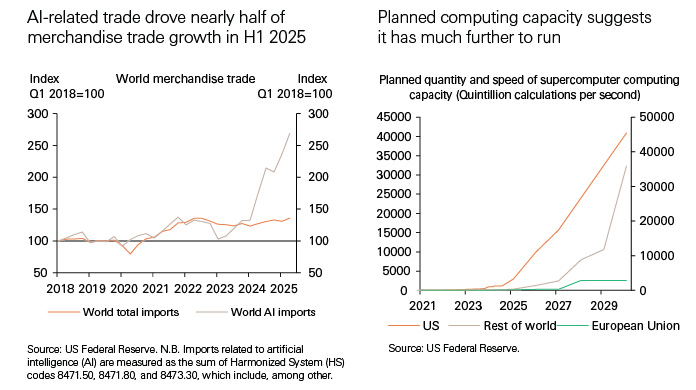
But what if this changes? The speed of AI improvements is so fast that the ways it can impact the world are changing weekly. It’s time to think about scenarios – and the ‘what ifs’. As a starting point, Fed Governor Michael Barr outlined, in a speech on 17 February 2026, a useful framework to think about what could happen with AI adoption in the coming years, presenting three different scenarios: gradual, rapid, and stall:
Scenario 1: Gradual adoption
- AI would proceed much like other general-purpose technologies, leading to strong productivity growth and some occupations would be displaced, while others emerge – widespread joblessness is avoided, though there may be a near-term rise in unemployment
Scenario 2: Rapid adoption
- AI capabilities would grow exponentially and quickly displace a range of professional and manufacturing occupations – big questions about the degree of unemployment and how policy responds
Scenario 3: AI capabilities stall
- AI proves incapable of completing hard tasks or complex projects, or an AI bust occurs as overinvestment becomes apparent – any productivity boost is modest
Within this – Scenario 1 is where we are today; a steadily increasing impact on the global economy. Scenario 3 would be similar in many ways – global growth may be slightly weaker than current expectations, although this may bring some asset price correction.
But scenario 2 is where things could get much more interesting. And whilst we would hesitate to put this as a base case right now, we need to start thinking about what such a shift could do to the global economy over the next five years or so should we clearly go down that path.
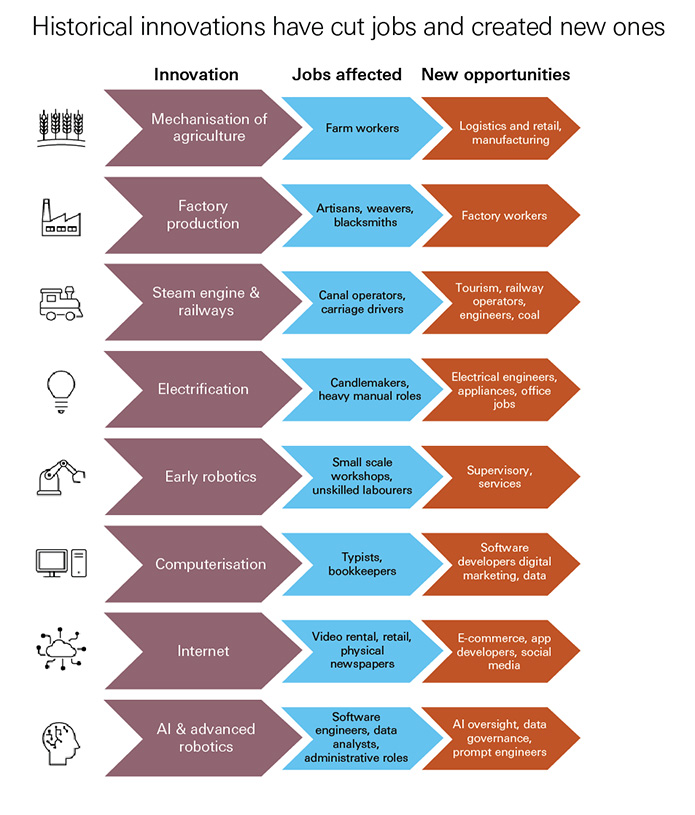
This would have huge implications for employment, productivity, and policy – and looking at the impact through the lens of our nine themes allows us to paint that picture. Consumption could become much more automated, as agentic commerce sees AI systems shop without human intervention, with digital finance (crypto) potentially playing a role; industrial robots, enhanced by AI, could solve some of our demographic problems, as older people grow as a share of the population; and automation in transport could reshape supply chains and trade flows. Meanwhile, in healthcare, medical AI tools could help with screening and bring down wait times, but professions like nursing, where human connection is crucial, could limit how far automation can really go. The energy transition will play a big role in determining if this is all possible, given the growing power demands from AI.
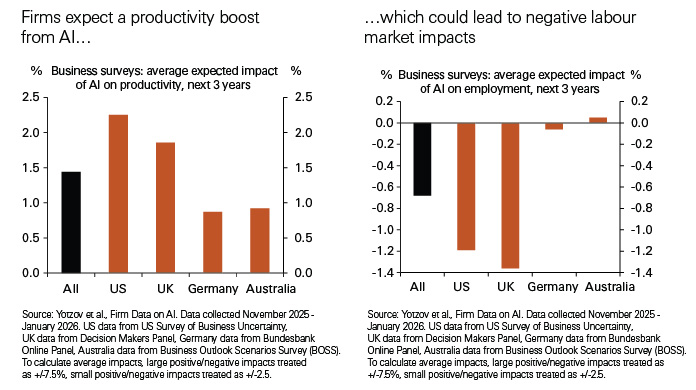
Given how big a shift this could imply for the global economy, we need to think about quite how dramatic the impacts could be if we end up heading down that path.
Would you like to find out more? Click here* to read the full report. Please note, you must be a subscriber to HSBC Global Investment Research to access this link.
To find out more about HSBC Global Investment Research, including how to subscribe, please email us at AskResearch@HSBC.com
*Please note that by clicking on this link you are leaving the HSBC Corporate & Institutional Banking website, therefore please be aware that the external site policies will differ from our website terms and conditions and privacy policy. The next site will open in a new browser window or tab
The following analyst(s), who is(are) primarily responsible for this document, certifies(y) that the opinion(s), views or forecasts expressed herein accurately reflect their personal view(s) and that no part of their compensation was, is or will be directly or indirectly related to the specific recommendation(s) or views contained in this research report: James Pomeroy and Bethan Ellis
This document has been issued by the Research Department of HSBC.
HSBC and its affiliates will from time to time sell to and buy from customers the securities/instruments, both equity and debt (including derivatives) of companies covered in HSBC Research on a principal or agency basis or act as a market maker or liquidity provider in the securities/instruments mentioned in this report.
Analysts, economists, and strategists are paid in part by reference to the profitability of HSBC which includes investment banking, sales & trading, and principal trading revenues.
Whether, or in what time frame, an update of this analysis will be published is not determined in advance.
For disclosures in respect of any company mentioned in this report, please see the most recently published report on that company available at www.hsbcnet.com/research.
Additional disclosures
- This report is dated as at 20 April 2026.
- All market data included in this report are dated as at close 14 April 2026, unless a different date and/or a specific time of day is indicated in the report.
- HSBC has procedures in place to identify and manage any potential conflicts of interest that arise in connection with its Research business. HSBC's analysts and its other staff who are involved in the preparation and dissemination of Research operate and have a management reporting line independent of HSBC's Investment Banking business. Information Barrier procedures are in place between the Investment Banking, Principal Trading, and Research businesses to ensure that any confidential and/or price sensitive information is handled in an appropriate manner.
- You are not permitted to use, for reference, any data in this document for the purpose of (i) determining the interest payable, or other sums due, under loan agreements or under other financial contracts or instruments, (ii) determining the price at which a financial instrument may be bought or sold or traded or redeemed, or the value of a financial instrument, and/or (iii) measuring the performance of a financial instrument or of an investment fund.
This document has been issued by HSBC Bank plc, which has based this document on information obtained from sources it believes to be reliable but which it has not independently verified. Neither HSBC Bank plc nor any member of its group companies (“HSBC”) make any guarantee, representation or warranty nor accept any responsibility or liability as to the accuracy or completeness of this document and is not responsible for errors of transmission of factual or analytical data, nor is HSBC liable for damages arising out of any person’s reliance on this information. The information and opinions contained within the report are based upon publicly available information at the time of publication, represent the present judgment of HSBC and are subject to change without notice.
This document is not and should not be construed as an offer to sell or solicitation of an offer to purchase or subscribe for any investment or other investment products mentioned in it and/or to participate in any trading strategy. It does not constitute a prospectus or other offering document. Information in this document is general and should not be construed as personal advice, given it has been prepared without taking account of the objectives, financial situation or needs of any particular investor. Accordingly, investors should, before acting on it, consider the appropriateness of the information, having regard to their objectives, financial situation and needs. If necessary, seek professional investment and tax advice.
The decision and responsibility on whether or not to purchase, subscribe or sell (as applicable) must be taken by the investor. In no event will any member of the HSBC group be liable to the recipient for any direct or indirect or any other damages of any kind arising from or in connection with reliance on any information and materials herein.
Past performance is not necessarily a guide to future performance. The value of any investment or income may go down as well as up and you may not get back the full amount invested. Where an investment is denominated in a currency other than the local currency of the recipient of the research report, changes in the exchange rates may have an adverse effect on the value, price or income of that investment. In case of investments for which there is no recognised market it may be difficult for investors to sell their investments or to obtain reliable information about its value or the extent of the risk to which it is exposed. Some of the statements contained in this document may be considered forward looking statements which provide current expectations or forecasts of future events. Such forward looking statements are not guarantees of future performance or events and involve risks and uncertainties. Actual results may differ materially from those described in such forward-looking statements as a result of various factors.
This document is for information purposes only and may not be redistributed or passed on, directly or indirectly, to any other person, in whole or in part, for any purpose. The distribution of this document in other jurisdictions may be restricted by law, and persons into whose possession this document comes should inform themselves about, and observe, any such restrictions. By accepting this report, you agree to be bound by the foregoing instructions. If this report is received by a customer of an affiliate of HSBC, its provision to the recipient is subject to the terms of business in place between the recipient and such affiliate. The document is intended to be distributed in its entirety. Unless governing law permits otherwise, you must contact a HSBC Group member in your home jurisdiction if you wish to use HSBC Group services in effecting a transaction in any investment mentioned in this document.
Certain investment products mentioned in this document may not be eligible for sale in some states or countries, and they may not be suitable for all types of investors. Investors should consult with their HSBC representative regarding the suitability of the investment products mentioned in this document.
HSBC and/or its officers, directors and employees may have positions in any securities in companies mentioned in this document. HSBC may act as market maker or may have assumed an underwriting commitment in the securities of companies discussed in this document (or in related investments), may sell or buy securities and may also perform or seek to perform investment banking or underwriting services for or relating to those companies and may also be represented on the supervisory board or any other committee of those companies.
From time to time research analysts conduct site visits of covered issuers. HSBC policies prohibit research analysts from accepting payment or reimbursement for travel expenses from the issuer for such visits.
HSBC Bank plc is registered in England No 14259, is authorised by the Prudential Regulation Authority and regulated by the Financial Conduct Authority and the Prudential Regulation Authority and is a member of the London Stock Exchange. (070905)
© Copyright 2026, HSBC Bank plc, ALL RIGHTS RESERVED. No part of this publication may be reproduced, stored in a retrieval system, or transmitted, on any form or by any means, electronic, mechanical, photocopying, recording, or otherwise, without the prior written permission of the issuer of the report.
This document is not and should not be construed as an offer to sell or solicitation of an offer to purchase or subscribe for any investment or other investment products mentioned in it and/or to participate in any trading strategy. It does not constitute a prospectus or other offering document. Information in this document is general and should not be construed as personal advice, given it has been prepared without taking account of the objectives, financial situation or needs of any particular investor. Accordingly, investors should, before acting on it, consider the appropriateness of the information, having regard to their objectives, financial situation and needs. If necessary, seek professional investment and tax advice.
The decision and responsibility on whether or not to purchase, subscribe or sell (as applicable) must be taken by the investor. In no event will any member of the HSBC group be liable to the recipient for any direct or indirect or any other damages of any kind arising from or in connection with reliance on any information and materials herein.
Past performance is not necessarily a guide to future performance. The value of any investment or income may go down as well as up and you may not get back the full amount invested. Where an investment is denominated in a currency other than the local currency of the recipient of the research report, changes in the exchange rates may have an adverse effect on the value, price or income of that investment. In case of investments for which there is no recognised market it may be difficult for investors to sell their investments or to obtain reliable information about its value or the extent of the risk to which it is exposed. Some of the statements contained in this document may be considered forward looking statements which provide current expectations or forecasts of future events. Such forward looking statements are not guarantees of future performance or events and involve risks and uncertainties. Actual results may differ materially from those described in such forward-looking statements as a result of various factors.
This document is for information purposes only and may not be redistributed or passed on, directly or indirectly, to any other person, in whole or in part, for any purpose. The distribution of this document in other jurisdictions may be restricted by law, and persons into whose possession this document comes should inform themselves about, and observe, any such restrictions. By accepting this report, you agree to be bound by the foregoing instructions. If this report is received by a customer of an affiliate of HSBC, its provision to the recipient is subject to the terms of business in place between the recipient and such affiliate. The document is intended to be distributed in its entirety. Unless governing law permits otherwise, you must contact a HSBC Group member in your home jurisdiction if you wish to use HSBC Group services in effecting a transaction in any investment mentioned in this document.
Certain investment products mentioned in this document may not be eligible for sale in some states or countries, and they may not be suitable for all types of investors. Investors should consult with their HSBC representative regarding the suitability of the investment products mentioned in this document.
HSBC and/or its officers, directors and employees may have positions in any securities in companies mentioned in this document. HSBC may act as market maker or may have assumed an underwriting commitment in the securities of companies discussed in this document (or in related investments), may sell or buy securities and may also perform or seek to perform investment banking or underwriting services for or relating to those companies and may also be represented on the supervisory board or any other committee of those companies.
From time to time research analysts conduct site visits of covered issuers. HSBC policies prohibit research analysts from accepting payment or reimbursement for travel expenses from the issuer for such visits.
HSBC Bank plc is registered in England No 14259, is authorised by the Prudential Regulation Authority and regulated by the Financial Conduct Authority and the Prudential Regulation Authority and is a member of the London Stock Exchange. (070905)
© Copyright 2026, HSBC Bank plc, ALL RIGHTS RESERVED. No part of this publication may be reproduced, stored in a retrieval system, or transmitted, on any form or by any means, electronic, mechanical, photocopying, recording, or otherwise, without the prior written permission of the issuer of the report.
Global Economics Quarterly - Running out of gas?
Early 2026 has given us the clearest evidence yet that we are living in a less stable, less predictable world, driven by geopolitical shifts: Venezuela, Greenland and now, as the humanitarian crisis and hostilities continue in the Middle East, the global economy faces the biggest disruption to global oil supply in history.